

When trust increases, optimism overpowers grievance.
Some of the most successful ventures I’ve been involved in over the years have placed a wildly disproportionate emphasis on team and individual happiness.
Some have used very unorthodox methods.
Work hard, play hard
For example, one such company had a work hard, play hard policy but no matter how late they partied in the evening, (and party they did!) all team members were expected to be at their desks by 09:00 the following morning, rain, hail, shine or screaming hangover – as was often the case. But team members always showed up, full of enthusiasm and willing to work hard for the team – and company – they enjoyed so much. And despite what readers may assume, this was not a highly creative, energised business like an ad agency, it was a very successful market research company!
Times have changed and such policies may no longer be considered ‘responsible’, but the lesson remains valid. Happiness leads to engagement and engagement delivers performance. At Aprais, we’ve long argued that high-performing client-agency teams are not only about skills, structure, and process, they’re also about people. And people perform best when they’re happy.
Recent global research, from sources as diverse as McKinsey, the World Economic Forum, and WARC, now provides compelling evidence that happiness at the individual level cascades into stronger, more resilient teams, and that happier teams are not only more engaged but also more productive and creative.
This growing body of data aligns with Aprais’ own findings over more than 28,000 client-agency evaluations worldwide: teams that score higher on relationship quality consistently outperform those that don’t. In human terms, relationships thrive when people feel valued, trusted, and happy – the very conditions that underpin both individual and collective success.
This growing body of data aligns with Aprais’ own findings over more than 28,000 client-agency evaluations worldwide: teams that score higher on relationship quality consistently outperform those that don’t. In human terms, relationships thrive when people feel valued, trusted, and happy – the very conditions that underpin both individual and collective success.
The business case for happiness
The business world has long accepted that engagement drives performance. What is now emerging is the deeper truth that happiness drives engagement.
In its recent Thriving Workplaces report, the World Economic Forum, in collaboration with the McKinsey Health Institute, quantified this hypothesis on a global scale. It found that improving employee health and wellbeing could generate up to $11.7 trillion in global economic value. That’s not a feel-good headline; it’s a hard economic case.
Organizations that prioritise employee health report:
- Increased productivity and reduced absenteeism
- Lower healthcare costs
- Higher engagement and retention
- Greater adaptability to change
McKinsey’s survey of 30,000 employees across 30 countries found only 57% reported good holistic health – a combination of mental, physical, social, and spiritual well-being. Put differently, nearly half of the world’s workforce is operating below its potential.
In today’s competitive environment, that’s more than a human concern, it’s a business risk. A workforce struggling with poor well-being is less creative, less collaborative, and less committed. Conversely, happier individuals form the foundation for stronger teams and better results.
From individuals to teams: the ripple effect of happiness
Team performance isn’t built in isolation. It’s the aggregation of individual energy, focus, and mood. Studies by the University of Warwick and Oxford University show that happier employees are between 13% and 20% more productive than their less happy peers.
The McKinsey/WEF report echoes this, suggesting that the biggest financial gains from wellbeing investment come from enhancing productivity and reducing “presenteeism” – when employees show up but operate below capacity. The estimated value of this improvement alone ranges from $2 to $9 trillion globally.
The psychological mechanism is clear: when people feel good about their work and their colleagues, they give more of themselves. Their creativity flourishes, resilience increases, and they communicate more openly. These qualities multiply across a team, reinforcing one another. Happiness, in other words, acts as a performance multiplier.
Employee engagement: the brand connection
While happiness drives engagement, engagement in turn drives brand strength.
A recent WARC report, What’s Working in Employee Engagement, underscores this connection. It concludes that brands with engaged employees deliver better customer experiences, higher profitability, and stronger loyalty.
In WARC’s words, employees “aren’t simply cogs in a machine.” They are the brand’s most influential touchpoint – the first and often most enduring expression of a company’s promise to its customers. When employees feel inspired and connected, they become natural brand advocates.
WARC’s guidance is practical:
- Treat employees as internal stakeholders.
- Ensure they understand and believe in the brand’s purpose and identity.
- Create a culture that aligns employee behaviour with business goals.
- Recognise the emotional cycle of engagement — knowing, feeling, believing, behaving — and nurture each stage.
The message is consistent with Aprais’ philosophy: successful organisations don’t just manage performance; they cultivate belonging and purpose.
Happiness as a strategic imperative
Back in March 2023, Aprais published Happiness: A New Business Imperative, highlighting that happiness at work is more than a “nice-to-have.” It’s a measurable driver of success — both for individuals and for the teams they form.
The report noted:
"Happy employees are more likely to form better relationships, collaborate more effectively and stay with their organisations longer."
Two years later, the argument has gained even more traction. The World Economic Forum calls workforce health and wellbeing a “strategic necessity and substantial business opportunity.” As the report emphasises, managing human capital now requires the same discipline as managing financial capital.
This evolution is reshaping leadership. No longer is happiness a matter for HR policies alone. It sits squarely in the remit of the CEO and senior management.
Why happier teams perform better
The connection between happiness and performance isn’t abstract. It plays out through observable team dynamics:
- Greater collaboration – Happy team members communicate more openly and build trust faster.
- Improved creativity – Positive emotions broaden cognitive capacity, enabling innovative thinking.
- Higher resilience – Teams with emotionally supported individuals recover more quickly from setbacks.
- Lower turnover – Happier employees are more loyal, reducing the cost and disruption of churn.
- Stronger client relationships – Happy teams project confidence and empathy, both essential for client trust.
The evolving leadership role: how to build happier teams
So, what can leaders do to cultivate happiness that endures beyond superficial perks or slogans? Here are five evidence-based actions drawn from McKinsey, WEF, and Aprais insights:
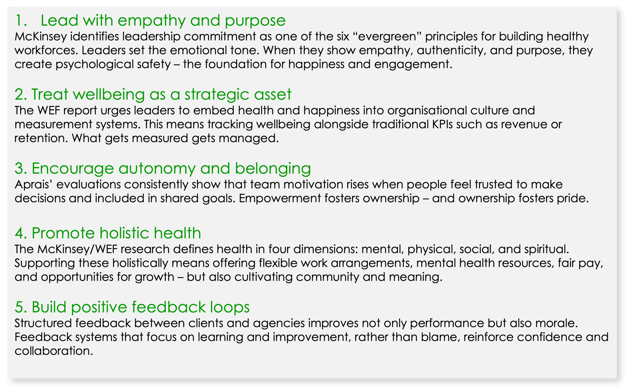
The cost of neglecting happiness
Ignoring happiness has tangible costs. Burnout, presenteeism, and disengagement silently erode performance. McKinsey reports that one in four employees globally now experience burnout symptoms, a figure that’s both alarming and avoidable.
Disengaged teams require more supervision, produce lower-quality work, and are less adaptable. In an industry like marketing and communications (where creativity and collaboration are essential) the cost of unhappiness is especially high.
Yet too many organisations still view wellbeing initiatives as peripheral, not central, to business strategy. The data from McKinsey and WEF makes it clear: the ROI on employee happiness is not just moral but financial.
Happiness as a competitive advantage
The most forward-thinking companies now recognise happiness as a competitive differentiator. McKinsey’s analysis shows that firms with higher employee well-being scores achieve superior returns on assets, stronger profit margins, and higher valuations.
Similarly, Oxford research found that companies ranking in the top quartile for wellbeing – the “Well-being 100” – outperformed major stock indices since 2021. Happiness, quite literally, drives shareholder value.
At a brand level, WARC reminds us that engaged employees are the ultimate ambassadors. They deliver better customer experiences and more authentic brand storytelling. This emotional coherence between brand and workforce strengthens reputation and long-term trust.
Small actions, big outcomes
While transforming organisational culture can feel daunting, the McKinsey/WEF report offers a simple philosophy:
"Do not let what you cannot do interfere with what you can do."
Leaders don’t need to launch sweeping programmes overnight. Small, consistent actions – recognising effort, encouraging flexibility, listening actively – accumulate into cultural change.
At Aprais, we see this every day in our client-agency evaluations. Teams that commit to regular, honest dialogue build trust and positivity over time. Their improvements are incremental but durable — and they lead to both better relationships and better business results.
The takeaway
Happiness isn’t the outcome of great teamwork; it’s the fuel for it. When individuals feel fulfilled and supported, they bring their best selves to the team. When teams are happy, they collaborate better, innovate more, and deliver superior results.
The message from Aprais, McKinsey, the World Economic Forum, and WARC is unified:
- Happiness is measurable.
- Happiness drives performance.
- And happiness starts with leadership
As organisations navigate uncertainty, the ability to cultivate joy, purpose, and trust at work may prove to be their most sustainable source of advantage.
Or, as we wrote in our earlier Aprais insight: “Happiness at work isn’t just about feeling good. It’s about doing better — together.”
References:
- McKinsey Health Institute & World Economic Forum (2025), Thriving Workplaces: How Employers Can Improve Productivity and Change Lives
- WARC (2025), What’s Working in Employee Engagement
- Aprais (2023), Happiness: A New Business Imperative